- The Innovation Armory
- Posts
- Snap is Glowing Up
Snap is Glowing Up
Moving into the Social Commerce Pole Position
Welcome back to The Innovation Armory! Today’s piece discusses Snap’s recently announced innovations at its Partner Summit and how these developments could propel Snap to lead the charge into creator-powered social commerce. Snap’s innovations analyzed in detail include:
Public Profiles for Businesses
API-Powered Content Lenses
Creator Marketplace
Layers Mapping
Story Studios & Spotlight
Scan & Screenshop
Enhanced Virtual Try-On
Connected Lenses and “Minis” UI
Bitmoji Integrations
Snapchat Spectacles Next Generation launch
Snap’s new set of features will in aggregate allow users to replicate a mall-like socialized shopping experience online whereby users can shop together by hopping from one connected lens to another through a social map of public business portals, brand sponsored “Mini” portals, all the while gaming with friends, virtually trying products and still reaping the pricing, discovery and convenience benefits of traditional online shopping. Read on for more!
This is a long post so if your email gets clipped at the bottom make sure to click unclip / visit The Innovation Armory to check out the full read.
For more real-time investing insights and meme content you can follow @SamNatbony on Twitter. You can share with the link below:
If you’re not already a subscriber you can subscribe below for future updates:
In “The Manifesto of Social Commerce: It’s For Real This Time”, I included Snapchat as an honorable mention for which technology platform would capture the most value from the shift to social commerce. At the time of writing, I didn’t think Snap had demonstrated a strong enough evolution to garner the top spot, lacking the commerce features, creator focus and discovery style to disproportionately benefit from this metamorphosis. Earlier this month at its Partner Summit, Snap revealed a highly differentiated and interesting set of new features, officially announcing to the social commerce world that it was glowing up:

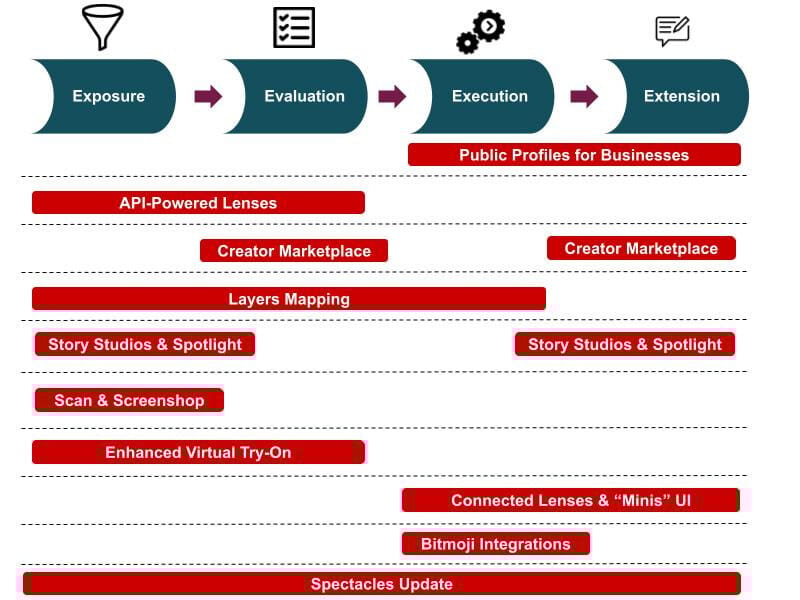
I previously set out the 4 Es framework of evaluating social commerce functionality: Exposure, Evaluation, Execution and Extension. Snap’s glow up attacks all four of these pillars and I believe this new feature launch could propel Snap into the pole position in terms of executing on a vision of frictionless, creator-driven social commerce. If Snap executes on these features and the cohesive vision they roll up into, Snap could leave some of its other social commerce competitors in the dust:

Below I break down Snap’s most salient feature releases and how they slot into each of the four key social commerce pillars. For more context on this framework, you should check out my manifesto on social commerce which provides the groundwork for much of the analysis I do of Snap in this piece.
Public Profiles for Businesses - public profiles give businesses a centralized hub to integrate content and commerce experiences into one social commerce portal. Through profiles, businesses can share public stories, showcase business snaps, publish A/R lenses and most importantly: integrate commerce portals with Snap content. This last point is critical because it allows brands to turn Snapchat into a native point-of-sale rather than merely building brand awareness on Snap but buying a product elsewhere. This builds much needed execution functionality to help shoppers execute on desired purchases in-app. Within the customer journey, profiles also help brands connect with consumers in the post-purchase extension phase by serving engaging product use case videos to users that have bought offerings. Moreover, relative to other business presence on Snap, these profiles are important because they allow brands to connect with potential shoppers by highlighting organic content generated from both key opinion influencers and internal content campaigns with permanence and a frictionless call to action. These profiles also provide a much needed “single source of truth” for the additional new functionality added for businesses which we will discuss. Interestingly, the commerce portals are done through an integration with Shopify, but Snapchat is both a) a platform to discover Shopify portals and b) an avenue to drive engagement with portals through content. Could it also be an interoperability layer to connect different portals through an integrated social shopping experience to drive cross-business shopper engagement? More on this later.
API-Powered Lenses - Snap also rolled out the ability for brands to build augmented reality powered shopping lenses with real-time product and pricing information. The use of these dynamic API filters provides more exposure to businesses who can create viral filters that are popularized by key opinion consumers. Once embedded within Snap UGC, these lenses also serve as customer product evaluation tools as they can dynamically update with relevant product comparison and contextual information. This lens update also better helps businesses engage with creators by ensuring creators that push a product share it with consistent and up-to-date product and brand information. On its backend, Snap also released more sophisticated lens analytics tools so businesses can better track lens performance and attribute conversion both to lenses and the creators that share the lenses in their posts. This allows brands to be more informed about how they engage creator’s through Snap’s new creator marketplace.
Creator Marketplace - Snap’s creator marketplace is initially connecting lens developers with business partners for businesses who want to leverage talent in the Snap network to design more engaging AR and lens content. Over time though, this marketplace will expand to encompass broader talent, influencers and content creators on the platform. This development is critical for a couple of reasons: First, key opinion consumers are a pivotal part of any social commerce ecosystem because they help confer social value on products to drive higher conversion for brands. Most of these key opinion consumers are creators within their own niche and so this marketplace is an important part of Snap’s creator retention strategy by providing more in-app monetization options for creators. This is incremental to Snap’s recently launched tipping offering as well (which has become pretty table stakes across consumer platforms). Second, these creators have a strong pulse on the Snap community and collaborating with them will help businesses be more successful in engaging with users on Snap through content campaigns. Moreover, it provides businesses another way to buy discovery opportunities through showcasing their brand in collaboration with creative talent. Content collaborations influence consumer perceptions of brand and therefore help brands push relevant content for the “evaluation” phase of the customer journey. These collaborations can also generate content that drives brand reinforcement post-purchase. There are multiple unique benefits of the Screenshop commerce model:
Layers Mapping - Snap already has a social map that allows users to see where there friend base is located throughout the world. Layers mapping gives users the ability to choose to augment their social maps with additional content from third party development partners. It is important to note that brands can’t just push content to users without consent, but rather users need to specifically add a partner integration layer onto their map. For example, users can choose to add an “Infatuation” layer with recommendations for restaurants and local experiences. I think this development is fascinating for a couple of reasons: First, it integrates product and experience discovery directly into the social map to reduce friction in the discovery process. It is an interesting way to drive potential experiential impulse purchases by letting third party developers surface potential purchases that are geographically and contextual relevant. Second, it effectively allows strong media brands (implemented through third party development partnerships) to create their own curated marketplaces for experiences and stores in your area. However, these developers need not be media companies, they can be creators who want to recommend experiences and products around you. While this functionality is starting in partnership with traditional media and tech brands, I believe it will eventually become another way for creators to connect with their fans all while showcasing products and experiences in an authentic and local way that creates engagement for brands and small businesses. Third, this map quite literally becomes the interface to map out the public business profiles to which users subscribe, providing a visualization layer to connect the local businesses and creators you are most interested in (i.e. an interoperability layer to shop your favorite brands). I’d bet snap will build in additional tools into its filters, spotlight and business profile pages to enable users to more seamlessly add a new overlay to their map based on content exposure through Snap. The content on this augmented social map helps consumers discover and evaluate products and experiences. I expect Snap will allow customers to make purchases (Either e-commerce or for in-store pickup through the social map) and expand this new feature to the execution layer as well. This feels like a much more organic expansion into a location-based social network (Foursquare without the check-ins?) that has the pre-existing user base and engagement to actually succeed and add value. Before these updates, did anyone else worry Snap social map was just a tool for stalkers?
Story Studios and Spotlight- In addition to the creator marketplace, Snap has launched a portfolio of new tools targeted at helping their creators. Story Studios is a suite of video editing tools to help amateur creators generate more professional looking videos, similar to ByteDance’s CapCut. These tools will help even more amateur Snappers with a following create more compelling videos both in collaboration with businesses through the creator marketplace but also to share through Snap’s competing offering to TikTok, Snapchat Spotlight. Launched back in November, Spotlight already has over 125M+ users and is another important tool to retaining creators by helping quality content get discovered thereby improving creator visibility. More professional content will help improve brand exposure by creating more compelling creator videos on behalf of brands and help bridge Snap’s content quality gap vs. TikTok
Scan & Screenshop - Snapchat has had a “Scan” feature for awhile now, which allows users to scan objects in the real world and receive relevant augmented information and context on that item. At the Partner Summit, Snap revealed a Screenshop feature that allows users to scan specific items and also have the opportunity to then purchase either that item or a recommended / related item within the app. A lot of the initial use cases revolve around apparel where you can scan outfits and buy online, but there is an unlimited opportunity set of what could be done with this functionality:
Imagine scanning a steak and Snapchat surfaces red wine pairing recommendations
Imagine taking a picture of your car and Snap’s object recognition identifies multiples scratches in the body or needed repairs and then surfaces recommendations for local autobody shops
Imagine taking a picture of a huge bug you found in your house that you share with your friends and Snap surfaces recommendations for local exterminators
High Impact & Contextual Conversion - Snap can leverage the camera and image recognition as a way of identifying an unspoken / non-communicated product need or help catalyze a purchase through a recommendation. This is a unique commerce format that is difficult to replicate and provides access to the customer at a high probability, contextual moment. For example, if you take a picture of a light fixture at a restaurant, you are probably snapping that picture because you think it’s cool. I think that your willingness to take your phone out, snap a picture and share with your friends shows a greater willingness to buy that item than merely clicking on a Facebook browser ad. Moreover, the act of taking the picture is sometimes contextual enough to improve the probability of conversion. For example, if you take a picture of your fridge, after recognizing the object, Snap might reasonably assume you were hungry and wanted to order food. The point is that Screenshop lets Snap target you for purchases in a contextual, high impact way rather than by tracking your personally identifiable information over time.
Hijack The In-Store Experience - Depending how integrated this feature becomes with Snap’s core features, Screenshop effectively turns every moment of your life that you document into a part of the online discovery process whether that be with content that educates you about a product or an opportunity to buy a product. It is interesting to consider how this intersects with offline retail. How many of you have FOBO (Fear of Better Options) when you are about to buy a product in a retail store but worry that there’s a better design, price or selection online? Do you scramble to Google around to see if you can validate a better option before you buy?At scale, the power of this feature could allow you to scan a shirt in Gap and have Snap present you with a) a price comparison, b) with similarly designed shirts at other stores and c) the ability to order in-app the alternate good if you prefer. This effectively hijacks the in-store experience and in my opinion turns the retail store purely into a showroom to try and see products for entertainment purposes. Snap does need to be careful with how it positions Screenshop to gain buy-in from traditional retailers. However, despite some risk of (further) obsolescence in their store footprints, most retailers will want to still leverage this channel due to its low consumer friction and relatively high probability of conversion. Bonobos is a great example of a retail business that leverages showrooms without inventory to drive sales. I think there is an interesting retail business to be built that customizes its real estate and product showcasing strategy to the Snap Screenshopping experience.
Shoppatainment - Snap’s traditional Scan feature historically has been a way to access augmented content rather than shop. By mixing the content that is served going forward between entertainment augmentation and commerce augmentation, the Screenshop & Scan integrated features effectively meld entertainment, commerce and education (for example: Snap recently announced a partnership with Re:Wild surrounding augmented reality environmental content). This builds on live streaming as a shopping format which also melds entertainment and shopping.The main limitation here is the quality of the data tagging, i.e. the ability to link any given object to the desired item or a recommended item. However, I believe retail partners are incentivized to work collaboratively with Snap to improve tagging quality for top-selling items to improve their own ROI on Snap as a marketing channel. Moreover, the API-powered lenses leverage data that could be utilized to optimize tagging for Screenshop. Lastly, with regards to recommendations, Snap can augment its image recognition with data from previously consumed content by that user to generate more bespoke product recommendations.
Enhanced Virtual Try-On - in “The Manifesto of Social Commerce”, I interviewed the executive team at Perfect Corporation to discuss virtual try-on for makeup. Perfect is actually one of Snap’s partners to power makeup try-on, but Snap’s virtual try-on cuts across product categories into apparel and fashion. They can also be activated by voice command so users can seamlessly transition between different outfits. The clothing try-on is powered by AI technology added when Snap acquired Ariel AI in January 2021 which builds 3D model renderings of the body to layer clothes on top of. Virtual try-on in clothing has eluded retailers for a while, but can drive more conversion in apparel and fashion in particular by providing customers more conviction before they execute on a purchase. Further, this technology provides a really interesting way for apparel brands to reduce marketing costs. When advertising a new product, instead of either a) coordinating a physical photoshoot or b) sending product to a creator / influencer for a product placement campaign, even more amateur creators and tier 2 influencers could leverage “virtual clothing” for collaborations in the creator marketplace. This lets brands drive greater exposure to products with comparable marketing budgets through lower effective costs:

These lower effective costs spur a virtuous cycle whereby brands benefit from being able to push their products through a more diverse group of creators, which in turn spurs more product exposure. Further, on the creator side, this increases monetization opportunities for tier 2 creators and also increases the velocity at which creators can push out brand content.
Connected Lenses & “Minis” UI- In addition to standard lens functionality, Snap is launching a connected lens which dynamically links the same lens across multiple devices, effectively allowing individual users in different locations to manipulate the same augmented reality object simultaneously. While still in beta, this would have some pretty fascinating gaming applications as it would effectively enable multi-player augmented reality games to be played through Snap’s camera. In “The Manifesto of Social Commerce”, I discussed how Pinduoduo leverages games to create a call-to-action, incentivize users with post-purchase rewards and drive scarcity. I envision retailers leveraging these dynamic lenses to create micro-games to encourage more frequent purchases by consumers. Below are two potential examples of potential collaborative and competitive games leveraging this technology that could have really interesting commerce applications:

Once this feature is out of beta, Snap could allow third party developers affiliated with commerce brands to create mini games with the purpose of driving these sorts of competitive and collaborative purchases that are tailored to specific retail brands. Beyond these dynamic lenses, there are ample opportunities to further gamify the experience of sending a snap and tie that back into the commerce process. For example, if a user purchases a new sweater through Snapchat, the Scan functionality should be able to track when that object is displayed in subsequent pictures or videos sent by friends. This allows retailers to work with Snap to gamify the post-purchase process further by retroactively rewarding users with discounts / subsidies (either retroactively on that purchase or for future purchases) in exchange for sharing their purchase with friends with a tag back to the retailer. Snap knows the network size of that user on their backend and so should be able to calculate the economic benefit to the retailer of each share and can help the retailer price the discount as a win-win for both the company and the user.
In “This is Not a Phishing Email”, I talked about how the best AI features / products drive down model input costs by leveraging existing human workflows to tag data for free, thereby pushing these data maintenance costs onto the customer rather than bearing that cost as the business. Interestingly, Snap has the opportunity to leverage a similar opportunity for its business model. For products not purchased through or catalogued on Snapchat, Snap could incentivize users to post pictures of their products and tag basic information about those items in their pictures (name of item, retailer, etc.) and in exchange get discounts either at that same retailer on Snapchat or for a different retailer. This is a win for Snap because it leverages the consumer for free data tagging services, but also a win for the consumer and brand who each get discounts and greater brand awareness / product exposure respectively.

In July 2020, Snap launched “Minis”, which are effectively bite-sized applications that live within Snap to augment existing content. As part of its latest updates, Snap announced a new dashboard to allow users to pin, organize and aggregate all of their minis to improve their accessibility. I believe the roll out of connected lenses will drive the creation of more gaming focused “Minis” which will become more integrated over time with commerce minis already on the platform like those sponsored by Poshmark and Ticketmaster to drive more of a gamified shopping experience. The decision to make “Minis” a more prominent part of the UI and give users more control over which to pin, signals more investment into its native and interoperable third party app ecosystem.
Bitmoji Integrations - Snap has now officially integrated Bitmoji with Unity Software, allowing players of games made on Unity’s real-time development platform to play as their Snap Bitmojis. While this doesn’t seem like a big deal, I think it is interesting because it creates interoperability between Snapchat and the virtual worlds within Unity-based games. This makes the Bitmoji even more portable out of the Snap ecosystem into a variety of games and makes it more of a viable candidate to be the identity layer of the metaverse if Snap continues to integrate with additional virtual worlds. In “The Manifesto of Social Commerce”, I discussed the potential for an avatar based interface layer to connect commerce portals as a means of stitching together a social commerce ecosystem. Perhaps instead of avatars, the Bitmoji could create this interface of interoperable identity?
Spectacles - At the Partner Summit, Snap also unveiled its generation 4 Spectacles, which is its first set of glasses with augmented reality functionality built in vs. just photographing the world with your glasses rather than your phone. Check out the below video for details on the launch:
The Spectacles will only be available to a small portion of lens creators currently developing on Snap’s platform to create initial lens experiments and start building out a library of creative augmented reality experiences. Before the glasses are offered to consumers, Snap may sequentially provide exclusive access to brands, game developers and other potential augmented reality ecosystem creators to build out the Snap AR virtual world over the next decade before mainstream consumers adopt Spectacles at a more meaningful scale.
At scale, this creative library is effectively a hybrid metaverse of digital experiences, commerce and content that is stitched together and overlaid on top of our physical world with spectacles as the entry point. While the applications to and implications of the metaverse go way beyond social commerce, this piece is focused on commerce in particular. All of the social commerce functionality we have discussed stack on top of one another more meaningfully in a world of augmented reality. The layered social map becomes the digital dashboard from which users subscribe to and subsequently navigate to creator business profiles, “Minis” / native applications, real life games and creator content. I believe the concept behind Spotlight will eventually be applied to augmented reality content as well, but instead of discovering merely video talent, users will discover popular augmented reality experiences, many of which will be surfaced contextually by leveraging Snap Scan depending on one’s surroundings. Augmented reality connected lenses will enable users to collaborate and socialize with one another from afar while enjoying the same digital augmentation layer.
Applied to social commerce, this augmented reality layer will finally enable users to replicate a mall-like socialized shopping experience online whereby users can shop together by hopping from one connected lens to another through a social map of public business portals, brand sponsored “Mini” portals, all the while gaming with friends, virtually trying products and still reaping the pricing, discovery and convenience benefits of traditional online shopping.

All Innovation Armory publications and the views and opinions expressed at, or through, this site belong solely to the blog owner and his guests and do not represent those of people, employers, institutions or organizations that the owner may or may not be associated with in a professional or personal capacity. All liability with respect to the actions taken or not taken based on the contents of this site are hereby expressly disclaimed. These publications are the blog owners’ personal opinions and are not meant to be relied upon as a basis for investment decisions.